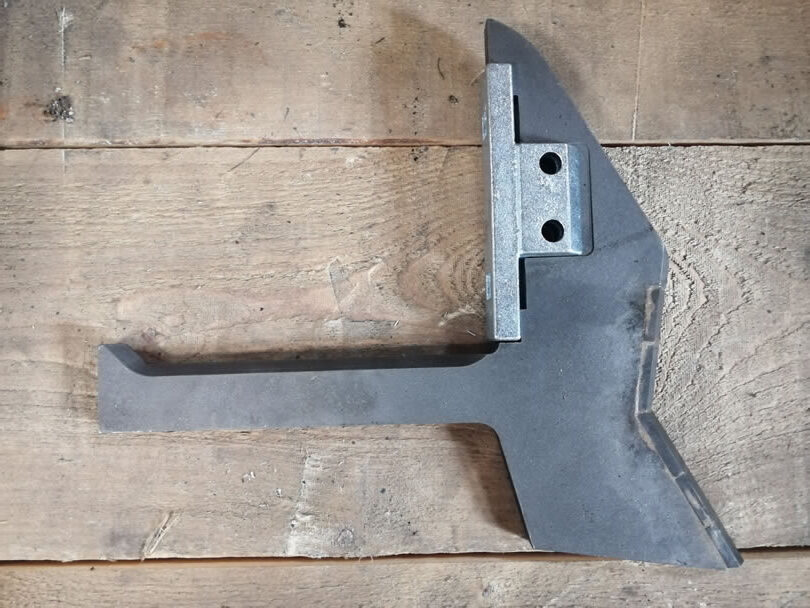
Frequently Asked Questions about the Triton Seed Drill
Why was a new rubber impact protection and vibration system introduced instead of using the existing beam clamps with four rubber rods?
While they are satisfactory on light disc harrow mountings or in light duty tine drills*, the beam clamps that pinch four rubber rods are simply not strong enough. The Triton is far too precise to have any movement or malfunction risk. The new rubber impact pad also allows the Drill to utilise individual tine lift features.
* Although, even in light duty, theses clamps move on the beams.
At what speed can the Triton work?
It is recommended to pull the Triton at a speed of between 8kmh and 18kmh. However, ensure your soil type and conditions allow the seed to be held at the right depth for the speed you are travelling. The faster the tines go through the soil the more the trash falls off the legs as they vibrate on the rubber impact pad system.
Which parts are patent applied?
Patents cover:
- the seeding blade design;
- the blade to leg design;
- the small seeds and soil interruptor tail;
- the seed-splitting tile;
- the side-press feature and closer blade;
- the vibrating rubber impact pads.
Do Triton parts fit any other manufacturers legs and brackets?
As far as we are aware, Triton parts only fit with other Triton parts.
Are drill components sold separately by Triton or in kit form?
Triton only sells seed drills as fully operational units. You can find a list of our Drill and parts prices here.
Can I make my own side-press drill if I don’t look to sell it?
It is a patent infringement for crops to be sold or fed or used for any commercial purposes if unlicensed patented parts and systems have been used in the crop production.
How long do the Tungsten pointed seeding blades last?
We estimate 2000 acres of use in medium loam/ clay soils on a 4m Triton Side-Press Seed Drill. However, this is an estimate because we have yet to wear any out yet. It takes about one minute to change a seeding blade.
Why is the Triton Side-Press Seed Drill maintenance free?
Apart from two sealed bearings on the depth wheels, the Triton has no moving parts. As a result, there is no wear and no greasing required. No replacement drill or expensive refurbishment will be needed, and the Triton will offer many years of hard work.
Do the seeding blades need to be changed for beans and rape?
No, nothing needs changing between crops. From grass seed and rape, cereals to maize, the drill is perfectly set up at all times. Only depth adjustment is needed, which takes approximately a minute’s preparation.
Can I get replacements and spares?
Triton replacement and spares can only be ordered direct via Triton Seed Drills. Only genuine Triton parts can be used on Triton manufactured seed drills. You can find a list of our Drill and parts prices here.
How is the slug issue reduced?
With the slot shut tight, the slug has no access to the seed and there are no clods to hide around. Also with the Triton, drilling in late November is an option and during this time of the year slug activity drops off due to the cold.
How do you deal with compaction?
The deep rooting seeding blades cut 6 inches deep into the field (vertical tillage). This gives air, drainage and deep rooting to every seedling which is a huge advantage over band seeders and disc seeders. The Triton Seed Drill is the only tine seeder which has this ability. The seed carrying bar which extends beyond the seed delivery tube, is vital for seed depth control in a deep slot drilling in row drilling system.
How do you prepare the land before drilling?
With a Triton Seed Drill there is no need to prepare the land, However, if you have a grass weed burden, the soil should be cultivated into a false seed bed by a shallow cultivator or by the Triton Drill being used as an aggressive stubble rake.
How is the black-grass burden reduced with the Triton Seed Drill?
Most black-grass germinates between mid October and Mid November. The Triton allows farmers to drill heavy clay soil effectively after this period, reducing grass weed burden. As the Triton allows the farmer to drill later, there is sufficient time to make false seed beds to control black-grass.
Importantly, from mid November onwards, the soil is generally damp so soil/root-acting herbicides are not lost to the air. Instead, they can easily travel down through the soil profile resulting in the chemical being all around and below the black-grass seed before it chits, allowing for the best possible control of black-grass. You can find out more about the Triton and black grass control here.